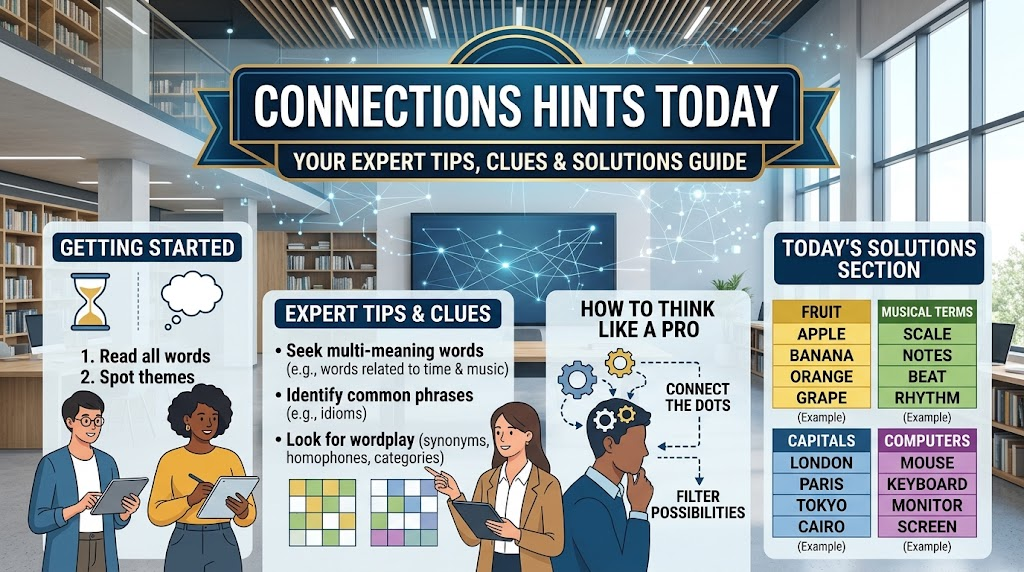
Welcome to your ultimate guide for solving the popular daily word puzzle. If you love testing your brain, you are likely searching for reliable Connections Hints Today readers rely on to keep their winning streaks alive. Word games have a special way of waking up our minds in the morning. When you look at a grid of sixteen random words, your goal is to sort them into four hidden groups of four. It sounds very simple at first glance. However, the puzzle creators love to trick you with words that seem to fit together in multiple ways. This guide will help you look at the board with fresh eyes. We will explore smart strategies, common traps, and easy ways to find the hidden links without spoiling all the fun. Let us dive right in and make you a puzzle master.
Understanding the Basics of the Game
To win the game, you must understand how the board is set up. You start with sixteen words on your screen. Your task is to find four distinct categories. Each category has four words that share a secret thread. You are allowed to make up to four mistakes before the game ends. Every time you make a correct guess, the game highlights your group. These groups also come with color codes. The yellow group is the easiest, followed by green, blue, and the tricky purple group. Knowing these color levels helps you plan your moves. You should always look for the easiest yellow group first. Clearing the simple words early leaves you with fewer items to worry about. This clever trick prevents you from getting overwhelmed by the remaining choices on your screen.
Why People Search for Daily Clues
Playing word puzzles every single day is a fun habit for millions of people. Yet, there are days when the words just do not make any sense. That is why looking for connections hints forbes style guides has become so popular. Sometimes, a tricky puzzle can ruin a long winning streak. People lead busy lives and do not want to spend hours staring at a screen. Getting a small nudge in the right direction saves time and reduces frustration. A good hint does not just give away the answer. Instead, it points you toward the theme. It acts like a friendly tap on the shoulder. When you use smart clues, you still get the joy of solving the puzzle yourself. It is all about finding that sweet spot between a tough challenge and a fun daily reward.
Spotting Red Herrings and Trap Words
The makers of this word puzzle love to play tricks on your brain. They often add words that look like they belong together. For example, you might see four words that are all types of fish. But only two of them actually fit the main category theme. The other two belong somewhere else entirely. These sneaky traps are called red herrings. They are designed to make you waste your precious guesses. Whenever you spot an obvious group right away, pause for a moment. Take a deep breath and check if there are five or six words that fit that same idea. If you find too many matches, step back. That is your sign that the puzzle has a trap. Look for alternative meanings, synonyms, or wordplay before you lock in your final choice.
The Power of Finding the Yellow Group First
Starting your puzzle journey with the yellow group is the best strategy. The yellow category is always the most straightforward part of the board. It usually features basic synonyms or very common word pairs. When you scan the sixteen words, look for the most obvious match. Do not overthink these initial choices. Once you find the four easy words, submit them right away. Clearing these words shrinks your puzzle board down from sixteen tiles to twelve. A smaller board is much easier to manage. It lets your brain focus on the harder blue and purple categories. Think of this step as clearing your desk before starting a big project. A clean space always leads to better focus and quicker puzzle-solving success.
Tackling the Tricky Green and Blue Groups
Once the easy words are gone, the real test begins. The green and blue groups are usually based on clever trivia, pop culture, or fill-in-the-blank phrases. You might need to know movie titles, famous brands, or parts of speech. If you feel stuck here, try reading the words out loud. Sometimes hearing the sound of a word helps your brain unlock a hidden memory. You can also look for prefixes or suffixes. Do these words all end with the same letter pattern? Can they all follow the word “fire” or “water”? Asking these simple questions changes your perspective. Do not be afraid to walk away from the screen for five minutes. Giving your eyes a short break often resets your focus instantly.
Decoding the Dreaded Purple Category
The purple group is famous for being the hardest part of the entire grid. It often relies on clever wordplay, silent letters, or fill-in-the-blank puzzles. For instance, the words might all be things that come before the word “board” or “cat.” Because these connections are so abstract, they are almost impossible to guess at the very beginning. In fact, many expert players leave purple for last. They do not even try to guess it. They simply wait for the other twelve words to disappear. Once the first three categories are solved, the four purple words fall into place automatically. This process of elimination is a totally valid way to win. You do not get extra points for guessing purple first, so use this smart shortcut whenever you need it.
Essential Tips to Improve Your Daily Strategy
Improving your puzzle skills takes a little bit of daily practice. First, try to build a broad vocabulary. Read books, articles, and trivia facts whenever you have spare time. Second, always use your scratchpad or mental notes. Before you tap any word on your screen, try to write down all four groups on a piece of paper. This physical act stops you from making rash choices. Third, pay close attention to capitalization. Sometimes lowercase words hide proper nouns or acronyms. Finally, do not let a lost streak ruin your mood. Puzzles are meant to be a fun escape from daily stress. Treat every single game as a fresh learning experience that sharpens your mind for tomorrow.
Complete Detailing Table of Puzzle Categories
| Category Level | Difficulty | Typical Theme Type | Best Strategy to Solve |
| Yellow | Easy | Direct synonyms or common items | Solve this first to clear the board quickly. |
| Green | Medium | Shared classifications or types | Look for categories like animals, tools, or brands. |
| Blue | Medium-Hard | Trivia, pop culture, or word associations | Say the words aloud to test fill-in-the-blank phrases. |
| Purple | Hardest | Wordplay, prefixes, or hidden links | Use elimination after solving the other three groups. |
Frequently Asked Questions
What are connections hints forbes readers look for?
Players look for daily clues, category themes, and strategic breakdowns that help them solve the New York Times word puzzle without ruining the fun of finding the final answers.
How many mistakes am I allowed to make?
The game allows you to make up to four incorrect guesses before it automatically reveals the correct groupings and ends your current game session.
Why is the purple category so difficult?
The purple group relies heavily on abstract wordplay, creative phrasing, and hidden linguistic patterns rather than simple definitions or direct synonyms.
Should I guess the hardest category first?
No, it is usually much safer to leave the purple category alone. Solving the yellow, green, and blue groups first makes purple much easier through simple elimination.
How can I stop falling for red herrings?
When you see a group of words that fit together too easily, check the rest of the board. If more than four words match that theme, look for alternative definitions.
Does playing word puzzles improve brain health?
Yes, daily word games and logic puzzles stimulate cognitive function, enhance vocabulary retention, and keep your memory sharp as you age.
Conclusion
Mastering daily word games is a wonderful way to keep your mind sharp while having fun. By using smart strategies, watching out for tricky red herrings, and tackling the board from easiest to hardest, you can protect your winning streak. Bookmark your favorite hint pages and use clues wisely whenever you hit a roadblock. If you enjoyed this guide, share it with a friend or fellow puzzle lover today. Dive into your next game with confidence, keep learning, and enjoy every single moment of your daily puzzle journey!