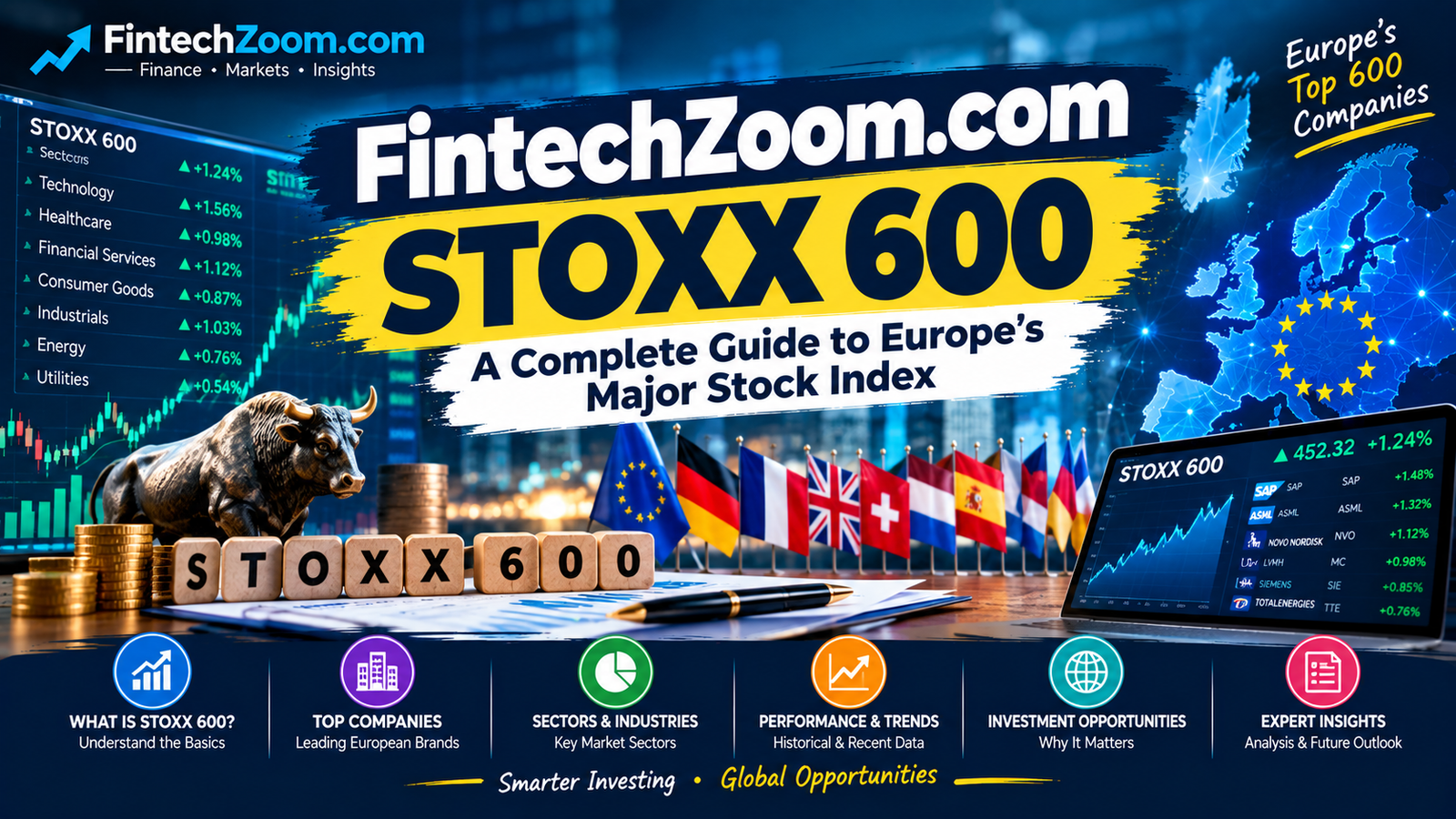
The FintechZoom.com STOXX 600 is a useful search topic for investors who want to understand European stock-market performance, index trends, and the companies influencing the region’s equity markets. The STOXX Europe 600, commonly called the STOXX 600, is one of Europe’s most important broad-market benchmarks. It tracks 600 companies across developed European markets and provides exposure to large-, mid-, and small-cap businesses.
Fintech and financial-market websites such as FintechZoom can help investors follow market movements, analyze economic developments, and understand how major indexes respond to changes in interest rates, inflation, corporate earnings, and investor sentiment.
What Is the STOXX 600?
The STOXX Europe 600 is a European stock-market index designed to represent a broad portion of the developed European equity market. It contains a fixed number of 600 companies and covers 17 European countries. The index includes companies of different sizes, making it broader than indexes focused only on the largest corporations.
The index is weighted according to free-float market capitalization. In simple terms, companies with larger publicly available market values generally have a greater influence on the index than smaller companies.
Because of its broad coverage, the STOXX 600 is frequently used as a benchmark for European equities and as an underlying index for ETFs, derivatives, and other financial products.
Why FintechZoom.com STOXX 600 Matters
Searching for FintechZoom.com STOXX 600 reflects growing interest in combining financial news, market analysis, and technology-driven investment information.
Investors can use financial platforms to follow index movements and examine the factors behind market changes. However, the STOXX 600 itself is maintained by STOXX, so official index information remains an important source when checking its methodology, composition, performance, and other technical details.
For investors, the index offers a convenient way to understand the overall direction of European equities without focusing exclusively on one country or company.
Countries Covered by the STOXX 600
One of the biggest advantages of the STOXX 600 is its geographic diversification. The index covers 17 countries, including:
- United Kingdom
- France
- Switzerland
- Germany
- Netherlands
- Spain
- Italy
- Sweden
- Denmark
- Finland
- Norway
- Belgium
- Austria
- Ireland
- Portugal
- Poland
- Luxembourg
The current index structure therefore gives investors exposure to several major European economies rather than concentrating investment in a single national market.
Major Sectors in the STOXX 600
The STOXX 600 covers numerous industries, which is another reason it is considered a diversified European benchmark.
According to the latest STOXX factsheet available, some of its largest supersector weights include banks, industrial goods and services, healthcare, technology, energy, insurance, food and beverages, utilities, consumer products, and financial services.
This sector diversity can help investors understand broader European economic trends. For example, rising interest rates may affect banks and other financial companies, while higher energy prices can influence energy producers and companies with significant operating costs.
How the STOXX 600 Is Calculated
The STOXX 600 uses free-float market capitalization weighting. This means the index considers the shares that are actually available for public trading rather than simply using the total number of shares issued by each company.
The index has a fixed 600 components and is reviewed quarterly. STOXX states that the index is calculated in real time, with regular dissemination during European market hours.
Quarterly reviews help keep the index representative of the European investment market while maintaining rules designed to limit unnecessary turnover.
STOXX 600 vs. Other European Indexes
The STOXX 600 is different from narrower indexes such as the DAX, CAC 40, or FTSE 100 because it covers companies from multiple European countries.
The FTSE 100 primarily represents major companies listed in the United Kingdom, while Germany’s DAX focuses on major German companies. France’s CAC 40 concentrates on leading French companies.
By comparison, the STOXX 600 provides a pan-European perspective. This makes it particularly useful when an investor wants to evaluate European equities as a broader asset class.
What Moves the STOXX 600?
Several factors can cause the STOXX 600 to rise or fall. These include:
- European economic growth
- Inflation
- European Central Bank interest-rate decisions
- Corporate earnings
- Energy prices
- Currency movements
- Political developments
- Global economic conditions
- Investor confidence
- Geopolitical risks
For example, recent market movements have demonstrated how quickly energy prices and expectations for European interest rates can affect the index. In September 2026, Reuters reported substantial STOXX 600 volatility as higher oil prices increased inflation concerns and influenced expectations for monetary policy.
Why Investors Follow the STOXX 600
Investors follow the STOXX 600 for several reasons. First, it provides broad exposure to European companies. Second, it can serve as a benchmark for evaluating European-focused investment portfolios.
If an investor owns European stocks and their portfolio significantly underperforms the STOXX 600, the index can provide a useful reference point for evaluating that performance.
The index is also important because financial products such as ETFs, futures, options, and structured products can use it as an underlying benchmark.
How to Analyze STOXX 600 Performance
When analyzing the STOXX 600, investors should avoid looking only at its daily price movement. A stronger analysis considers several factors.
First, examine the index’s longer-term performance. Next, consider sector performance because individual industries can behave differently during different economic conditions. Investors should also monitor European inflation, interest rates, economic growth, corporate earnings, and currency movements.
Valuation measures such as price-to-earnings ratios can also help investors determine whether European equities appear relatively expensive or inexpensive compared with their historical levels or other markets.
Risks of Investing Around the STOXX 600
Although the STOXX 600 provides diversification, it does not eliminate investment risk. European equities can experience substantial volatility.
Political uncertainty, recessions, changing interest rates, geopolitical conflicts, energy-price shocks, and weak corporate earnings can all negatively affect the index.
Currency risk is another consideration for international investors. An investor whose home currency is different from the currency of an investment product linked to the STOXX 600 may experience gains or losses from exchange-rate movements in addition to stock-market performance.
The Future Outlook for the STOXX 600
The future performance of the STOXX 600 will depend on the interaction of economic growth, inflation, monetary policy, corporate earnings, and global market conditions.
European companies also operate in industries positioned to benefit from long-term trends such as digitalization, artificial intelligence, infrastructure investment, energy transition, healthcare innovation, and industrial modernization.
At the same time, investors need to consider risks from inflation, higher financing costs, geopolitical tensions, and weaker economic growth.
Recent 2026 market data illustrates this balance. Reuters reported that the STOXX 600 had periods of strong performance but also experienced sharp declines when energy prices and inflation concerns increased.
Final Thoughts on FintechZoom.com STOXX 600
The FintechZoom.com STOXX 600 keyword connects financial technology, market information, and one of Europe’s most important equity benchmarks. The STOXX 600 provides broad exposure to 600 companies across 17 developed European countries and multiple economic sectors.
For investors, understanding the index can provide valuable insight into European stock-market trends. Rather than focusing on one company or country, the STOXX 600 offers a broader view of the region’s equity market.
However, investors should combine index analysis with research into economic conditions, company fundamentals, valuations, interest rates, and risk factors. Financial websites can provide useful market commentary, but official STOXX information should be consulted for authoritative index methodology and data.